Wednesday, April 10, 2013

an important workshop ... and his result

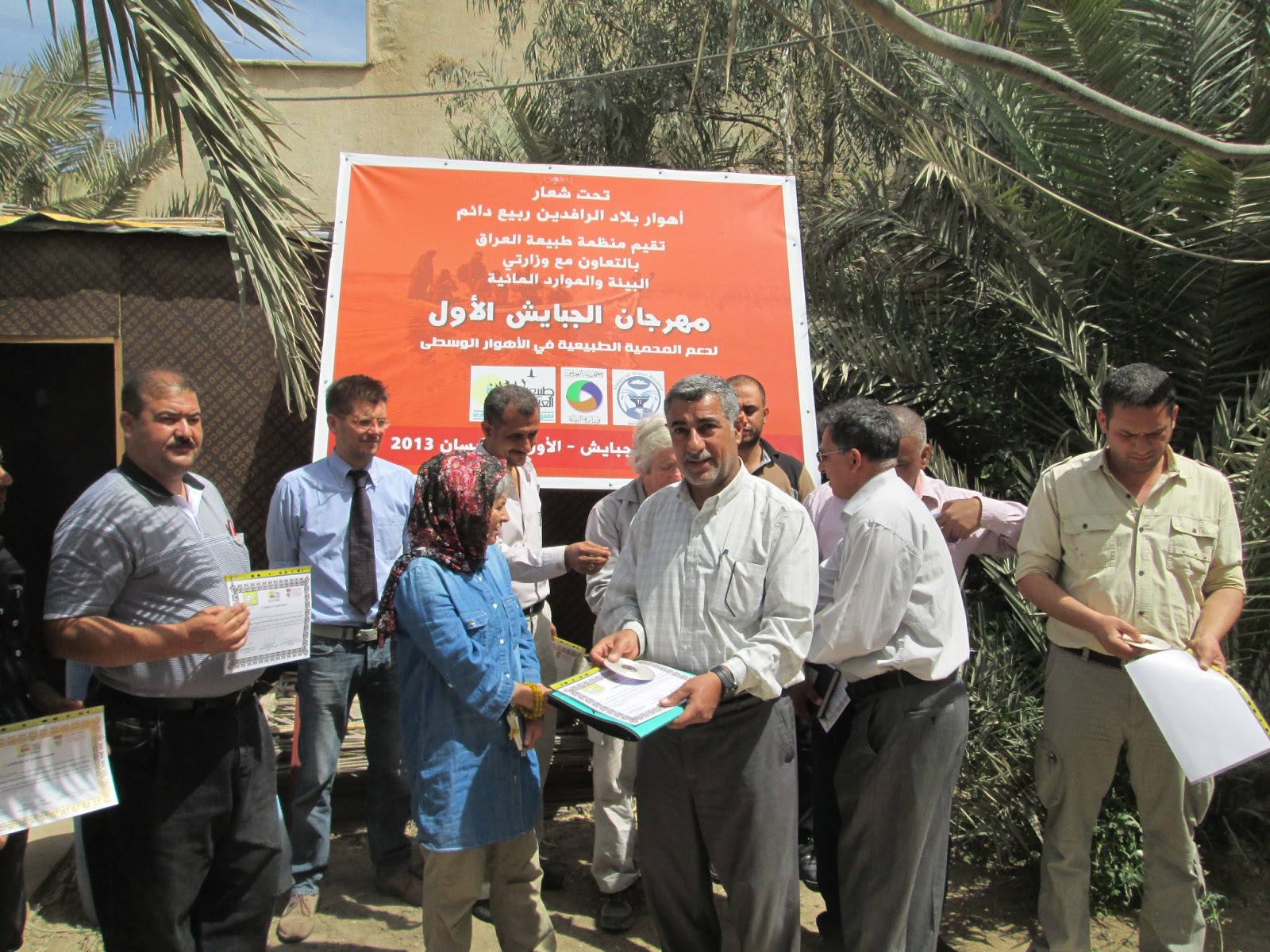
This is a great and emblematic picture.
This shows the team of technicians and members of the ministries and municipalities of Iraq who receive the certificate of participation in the workshop about "Treatment Wetlands with Wastewater gardens Technology" held in Iraq from 24 to 27 March 2013 (I'm the tie man... and with me Meridel Rubinstein and Mark Nelson).

About 25 participants know now what are the treatment wetlands technology and wastewatergardens, and can spread these information around this beautiful country. 
Thank you all of you!


Monday, April 1, 2013

constructed wetland in Iraq - my survey and my project

Well, after a week of survey, workshops and good local meals, I can show you some pictures about my activity there.
Yes Iraq can be considered a dangerous place, but I've met nice people, visited some very beautiful places and laid the foundation for a fruitful collaboration. Good luck to all of you in this journey of renewal.
I'll prepare a special post about the wastewatergardens technology and his team which gave me the opportunity to be an active part of this work. Thanks also to Meridel Rubistein to involve me in this international project!
I have visited four sites between the district of Nassirja and Basra. Two will be made to serve a local Shrine, one is for a private house and the last one is to serve the west part of the city of Chibaish. All sites are suitable.
Is not easy to start to work in a place where none know your technology, where you have to start from the base line of the functioning, where the climate is not your home weather, where you have to check all tha materials, where you have to found a local builders... etc. But is possible! and I'll explain what I have did.

First of all we have organized a good workshop with local people, members of the local municipality, Ministery of Water Resource and Environment, and anybody want to attend and learn more. Second we have visited the sites with the owners. Third we have contacted a local builders to discuss all about the materials and the construction steps. Fourth we have check the availability of the local species that can be used.
25 person attend at the three days of workshop. Thank to all of you!

site n. 1, the local men toilet discharge in the septic tank.... but we need also a beautiful wetland system! 

site n. 3: these men toilets need to go to the septic tank...which in a couple of months will done! 
YEAHHH also there there is washed gravel

checking the availability of pvc pipes, diameters ets...
discuss with a local gardener about the management of the plants

checking in a "mobile nursery" the price of the plants !!!!


Sunday, March 24, 2013

what you can do with the reeds from this Arab marches

here below I present what you can do with reed grown in these ancient Arab marches... all this is  Phragmites australis.....
here all the buffalo eat phragmites australis

the reeds are collected inside the Arab Marches and with the local boats the men goes to the market and sell it to the other farmer

reed dried under the sun...... or clothes driing under the sunset?
take a look to this beautiful reed mats ready to go to the market!

amazing reed mats waiting to go to the markets!

reed transportation
and obviously you can also build your houses!!!!!!


Saturday, March 23, 2013

iraq's ancient marches.... the Eden was here and we work to restore it!

Hi to all, yes is true, I'm here where the Eden begun!!! just few images from this first day. stay tuned for other in the next days


the Euphrate river

Sunday, March 10, 2013

Eden in Iraq

EDEN IN IRAQ

Ecological and Cultural Restoration through Art, Design, and Environmental Science in the  South Iraq  Marshes

Growing Beauty with the 7000 year old Marsh Arab Culture


Eden in Iraq is a land art project in the wetlands of southern Iraq using imagery and wastewater to create a garden to transform centuries of conflict into art. It will bring an effective, ecological treatment system for sewage and water recycling into a region which lacks such basic hygiene.

In 1991 Saddam Hussein drained the immense wetlands near the likely site of the Garden of Eden, turning it into a desert. The Marsh Arabs who were forced to leave have been returning to re-green and restore the marshes with the help of the Nature Iraq, an Iraqi NGO located in El-Chibaish, the largest Marsh Arab city in the region. Nature Iraq has invited artist Meridel Rubenstein and environmental engineer Dr. Mark Nelson, with landscape architect, Catherine Page Harris, to create an art/ecological work that will transform human waste into a garden, protecting the health of the local people and the rivers and marshes which sustain them. The project is also supported by the Institute of Ecotechnics .

The restoration of the priceless and historic Mesopotamian wetlands in southern Iraq is well underway. The work has been spearheaded by Dr. Azzam Alwash, an Iraqi-American engineer, founder of the Eden Again Project and Nature Iraq, with assistance from the Iraqi Government, the Canadian International Development Agency, the Italian Ministry of the Environment, Land and Sea, and the United Nations Environment Program. The area for millennia was home to the famed “Marsh Arabs” whose reed houses and reed boats, made from wetland reeds growing in the area made the region unique culturally. The area was heavily damaged during the decade-long Iran-Iraq war when sections were bombed and drained. After the uprising by the local peoples of the region against Saddam Hussein in the early 1990s, the Iraqi government in retaliation diverted the rivers and dried out most of the area, and forced most of the local population to move away. More recently, river flow has been restored and a good percentage of the wetland area is recovering, with an influx of Marsh Arabs back to their original homeland.

Nature Iraq is an Iraqi NGO (www.natureiraq.org) working on preservation of important ecological regions and distinctive cultures in Iraq. They have proposed the southern marsh area as the country’s first, the Mesopotamian National Park. The Institute of Ecotechnics (UK and US), founded in 1973, has been working on the theory and practice of integrating people, economics, technologies in sustainable relationships to our biosphere. IE holds conferences and workshops and consults to innovative projects around the world which serve as demonstrations of the ecotechnic approach.


the team:
Meridel Rubenstein, Project Director, is an Artist whose work focuses on the intersections of nature and culture in relationship to ecological and social imbalance. Presently she’s an Associate Professor at the School of Art, Design, and Media at Nanyang Technological University, in Singapore (Spring semesters only) where she teaches Photography, Installation, and Art and Ecology. She uses photography and sculpture to make her work. MA and MFA, Art Dept, University of New Mexico. http://www.meridelrubenstein.com
Mark Nelson, PhD is an Environmental Engineer, received his PhD with Prof. H.T. Odum at the
University of Florida Center for Wetlands. Director Institute of Ecotechnics, Santa Fe,NM , a member of the first biospherian crew in Biosphere 2) , and for the
past 15 years has been working globally on constructed wetland applications.
(http://www.wastewatergardens.com).
Catherine Page Harris, Assistant Professor of Art and Ecology, UNM Dept. Art and Art History,
is a landscape architect. Co-leader of Land Arts of the American West. Her current work focuses on interactions between ecological flows and human habitation. She creates mixed media installations and landscapes. Master of Landscape Architecture, UC Berkeley; Master of Fine Arts, Stanford University. http://cargocollective.com/landwork


Well, I'm really proud to annunce that I'm part this project by a Tier One Research grant  from  Nanyang Technological Unverisity. Stay tuned form upcoming news!!!


Tuesday, February 26, 2013

opinions on treatment wetlands

Hi,
Since 1996 I work in the field of treatment wetlands and I've heard of all colors (this is an italian way of saying to express  the fact that I have heard many speeches about TWs).

  • I'm sure that the wetland's cells doesn't smell,
  • I'm sure that the wetland's cells doesn't host wild animals that kill you
  • I'm sure that mosquitos cannot live there
  • You can walk on a vertical and horizontal beds; for the surface beds you need special boots or wearing the beautiful Hawaianas summer shoes
  • The wetland system last more than 20 years if you manage them well
  • They cost less than a traditional system (a little bit less but you have not the expensive management cost of the traditional systems)
  • Floating wetlands are a good way to treat on site the wastewaters
  • You can use local materials to build up the systems
  • You can use local species to plant the beds
  • Yes, it is true that the wetland needs land where build the beds.... but it is always better than a industrial area...


any other questions or opinions? help me to improve this list...

"greetings from Hamman-Jordan"

treatment wetlands on wiseGEEK

I was looking for something new about treatment wetland by a random research on the web and I found this portal "WiseGEEk" that  give clear answers for common question. I was wondering when I saw that there was an answer about treatment wetlands. that's good!

here the link to the web page: wisegeek treatment wetlands


Monday, February 25, 2013

hybrid constructed wetlands

Hybrid systems are a combination of vertical flow and horizontal systems arranged in a staged manner. HF systems cannot provide nitrification because of their limited oxygen transfer capacity. VF systems, on the other hand, do provide a good conditions for nitrification but no denitrification occurs in these systems. In hybrid systems (also sometimes called combined systems) the advantages of the HF and VF systems can be combined to complement processes in each system to produce an effluent low in BOD, which is fully nitrified and partly denitrified and hence has a much lower total-N outflow concentrations (J. Vymazal, Ecological Engineering, Volume 25, Issue 5, 1 December 2005, Pages 478–490 . Constructed wetlands for wastewater treatment, abstract.

When I start to design a wetlands I always ask to myself "horizontal or vertical ? or hybrid?". Well, is not difficult to answer! I take into account the volume, the number of people treated, the available surface, energy input, and so on.
Usually I start with the horizontal, easy to be design, easy to be realized, no energy needed, and a lot of advantages.
If I have more than 50, 100 .. 450 cubic meters a day I'm sure I do an hybrid wetland with VF before and HF after. Yes, if we are in a place where the surface is free, and where there are no other problem I do an HF, sure. But usually for large volumes is better the hybrid wetland. As noted in the Vymazal abstract, the chemical reactions that occour in the two systems are different. in the hybrid system we have both, and the treatment  efficiency will be higher in less space!

http://www.isprambiente.gov.it/files/pubblicazioni/manuali-lineeguida/Manuale_81_2012.pdf

For example you have to treat 100 m3 of municipal wastewater. 

1 Hp: only horizontal:
if you  build up only HF systems you need more or less 1800 square meters of treatment wetland

2 Hp: only vertical:
if you  build up only VF systems you need more or less 600 square meters of treatment wetland

3 Hp: hybrid system
if you  build up an hybrid wetland systems you need more or less 1200 square meters of treatment wetland

This comparison is not made for the capital cost of building and design, only to show you the difference between the design methods.
As you can see the VF surface is the lowest but usually you have to buy pumps systems and realize the tanks for the inlet pumping.
The HF have the highest surface but the lowest cost.
The hybrid is midway but be sure that will give you the best treatment performace you can reach because it combine aerobic and anaerobic environment.


Friday, February 22, 2013

WATER USE EFFICIENCY and FAO (Food and Agriculture Organization of the United Nations)


from FAO profile on facebook I copy this important article and also my comment. Yes, is important ot improve the water use ecciciency but is also important to start to reuse the treated wastewater. Treatment wetlands are a good way to treat wastewater and and give back H2O moleculae that could be reused for different purposes!

"The continuing population growth could double food demand in the next 50 years. Find out how better use of water could allow us to produce more food while preserving natural resources: http://bit.ly/XyGkOY"


and this is my comment:

"Davide Tocchetto: yes, is true, save water with improve efficiency but there is a large amount of water that can be reused, there are purification systems which allow to produce water that can be reused for different uses. One of this is treatment wetlands, a natural way to treat wastewater and get back clean water ... read more on www.treatmentwetlands.blogspot.com. A city with 100000 habitants produce 20000 mc a day of wastewater; this volume can generate 15000 mc/d of treated water that can be used for agriculture, irrigation, industrial processes. let's start to think also about the reuse!"


Friday, February 15, 2013

AQUAPONIC.... is a treatment wetland?


Aquaponics is a sustainable food production system that combines a traditional aquaculture farming with hydroponics in a symbiotic environment. 

In aquaculture, effluents accumulate in the water, increasing toxicity for the fish. 
This water is led to a hydroponic system where the "nutrients" from the aquaculture are filtered out by the plants for their life, after which the cleansed water is recirculated back to the animals.

Aquaponic systems vary in size from small indoor or outdoor units to large commercial units, using the same technology. The systems may contain fresh or salt water, depending on the plants and animals desired. (source, wikipedia mod.).

Now I'm partner in a Leonardo project with University of Padova and Lubiana, the Swiss ZAHW and three high schools (in Italy, Slovenia and Swiss). The aim of the project is realize an aquaponic system in the two schools.
But my question is... is aquaponic a kind of treatment wetlands? I think yes!
Yes because there is wastewater produced by the fish farming and yes because there is the biological absorption by the plants and finally the treated water is reused for the fish living...


A good example on expanding aquaponic culture is the URBAN FARMERS project in Swiss (UF web site). They are focused on building the best urban agriculture systems the world has ever seen. They are cost effective, sustainable and reliable. Their rooftop farm system grows fresh vegetables and fish, and adds a new experience for your customers. The proprietary hardware and software solution which we have developed keeps your farm working and connected to your community so anyone can see, smell, and taste the truly fresh food, anytime. (source UF web site). 
Take a look to thier UF globe project at http://urbanfarmers.com/productsservices/uf-globe/ it's fantastic!!! 
Here below a picture of the aquaponic module in ZAHW.


Thursday, February 7, 2013

permaculture and treatment wetlands

Permaculture is a branch of ecological science which develops sustainable architecture and self-maintained horticultural systems modeled from natural ecosystems.The design principles which are the conceptual foundation of permaculture were derived from the science of systems ecology and study of sustainable land use. Permaculture draws from several disciplines and  has been applied most commonly to the design of housing and landscaping, integrating techniques such as agroforestry, natural building, and rainwater harvesting within the context of permaculture design principles and theory (source: wiki mod).


On the web I have found The  Permaculture Research Institute of Australia that  work with individuals and communities worldwide to expand the knowledge and practice of integrated, sustainable agriculture and culture using the whole-systems approach of permaculture design. This will provide solutions for permanent abundance by training local people to become leaders of sustainable development in their communities and countries (source http://www.permaculturenews.org/about mod). very interesting web site, join it!!!!

.... and what do you think? do you think the treatment wetlands may not be a suitable systems? OHHH YESSS, take a look to the australian research site, you will find a good read about treatment wetlands. I want to mention them with his words reported below:

"These artificial wetlands provide a near zero energy input way to treat local effluent with no negative side effects. The process is free of both chemicals and odours, provides habitat for wildlife, increases the diversity and aesthetics of any site, and, depending on the toxicity of the inflowing effluent, can potentially create a yield, such as fodder for livestock." 

very good words! congratulations


Wednesday, January 30, 2013

follow this blog by e-mail

Ciao readers, hello wetland's friends ... please join the service " FOLLOW BY E-MAIL" that you find here in the  right sidebar. You will be update immediatly when I'll post the new articles.


Tuesday, January 29, 2013

my future on treatment wetland systems


For several years we are developing a product that will bring an extraordinary novelty in the field of wastewater treatment and its application on a large scale. As usual, the idea is good, the industry requires, its competitors are there but our product is better, blah blah blah.
The product is based on our experience in the field of treatment wetland  and have developed a good project idea to make this system with high aesthetic value, which is applicable in many realities, both Italian and foreign, and of course with sustainable positive impact.
To continue this adventure we  search designers who want to try to produce the true aesthetic and functional innovations in the coming years (Bill Gates is investing with his Foundation a lot of dollars in sustainable sanitation); seek investors who want to invest in the water sector and of water sanitation and health care to produce wealth and good for the environment and human beings.
We do not give the indifference of native capitalists we met in the last months........ Soon we will find an open door.

Wednesday, January 23, 2013

Sustainable architecture in action: constructed wetland in the Gaza Strip

bouncing from site Building Green Futures an update of the TW in Gaza Strip to whom I have collaborated:


early 2012

early 2013


"These images show the growth over a 12-month span of the constructed wetland engineered by Mauro Lajo (Artecambiente) in the Kindergarden of Um Al Nasser (North part of Gaza Strip), an eco-friendly school built in 2011 by ARCO’, Mario Cucinella and the NGO Vento di Terra.

The Garden uses green plants and associated microorganisms for degradation, removal and/or reduction in the concentration of pollutants in the school’s grey waters that can thus be reused for toilet flushing and gardening. Underneath the garden lies a tank for the harvesting of rainwater. "


Building Green Futures has been following from very close the progress in the design and construction of this building, a great example of low-tech/high performance sustainable design bringing lasting benefits to people in need.

Building Green Futures (BGF) is a not-for-profit organization created by Mario Cucinella Architects to promote sustainable development through green architecture and urban regeneration. With Building Green Futures, the quality of the design work produced by MCA and its partners contributes to initiatives for social good


Using BGF as a vehicle, the resources and the experience of MCA contribute to philanthropic causes such as:

1) “Design & Build” projects in support of development programmes and humanitarian interventions;

2) Knowledge Transfer & Science Communications for dissemination of best practices on sustainable architecture and green technologies.

3) Applied Research for social innovation


Monday, January 7, 2013

a good margin of improvement...

well, welcome back from this long two weeks of holidays. I begin this 2013 with a post that explain what you must not do about a treatment wetland system. Yesterday I had lunch in a restaurant where four years ago I have design and build with a good italian company a constructed wetlands. Before sitting down at the table I went to see the system.... and the photo below show what was there. 
First of all I write you that when we finished building it we have had an idea of the local manager and we think that it wasn't the right person to manage the system. We suggent to plant some species and he has used other, we have suggested the bacis management rules and he said " I know what I have to do... ". Well, this is the result when your client is not the best.
photo 1: the inlet
 As you ccan see in the photo 1) the importance of the Artec Filtering System ( buy it at www.artecambiente.it or contact me, I can give you the details of this good solution). This wastewater came from the bath and from the kitchens. The basic design guide say that the Imhof tank and the fat-trapper must to be cleaned two time a year....but as you can see a lot of solids and other particulate arrive here in the inlet. The good role of the  filter is shown but a lot of problems are before the filter.
photo 2: the outlet
 The output shows that the wastewater has been partially treated by the wetland system, there are not solids, there are not opacity and there are not fat or foam. Well... but is is partially treated and is not a good water to be sent in a freshwater channel.
photo 3: the surface
... and the photo three shows you which is the situation above the gravel. In the beginning of the project we suggest to plant phragmites australis and iris pseudacorus .. but he chose typha (We suggest iris and phragmites because the flowering of iris is the best in this public area). After 4 years this is the result, only ten group of plants are alive. this mean that only 20% of the wetlands surface is covered by plants and only 20%  of the whole system treat the wastewater. You can image that also the treatment performace are really low. 
(no smell rise from the whole surface area, only when I opened the intet tank it smell of wastewater)

I entitled this post "a good margin of improvement...".. yes ...few operations can be done to properly manage a treatment wetlands, please do it! 
- clean the Imhof tank
- clean the fat-trapper
- use right species
-.... listen your designer..

and after the visit to the system I had wash my hand...

have a good time and happy new 2013!


Wednesday, December 19, 2012

Merry Christmas and Happy New Year

Hi to all, with my post n. 100... I wish you a Merry Christmas and a big Happy New Year full of happyness and love!!!


wastewater treatment with algae...

I love the algae world and a lot of things can be done with these spectacular mico-organisms. Pharmaceutical, proteins, cosmetic... and also wastewater treatment.. yes, algae live with nitrogen and phosphorus that are common pollutants.

Copied from the http://www.oilgae.com web site I can summarize the following text:
" Algae are an important bioremediation agent, and are already being used by many wastewater facilities. The role that algae can play in wastewater remediation is however much higher than its current role.
Use of algae as the bioremediation agent enables us to solve two key problems: increased use of chemicals and high energy costs. Thus, algae-based waste water treatment is a powerful avenue for sustainable wastewater treatment.
Algae-based remediation of wastewater is not without its challenges; however, the potential is so high and the problem so critical that there are a number of research efforts - both in the academia and in the commercial sector - ongoing in order to address these challenges."
A good report can be dwnld or buyed in the oilae.com web site..

Another good reading with a literature review is here...tidskriftenvatten.se  as pdf document named "WasteWater treatment With microalgae – a literature review" written by Karin Larsdotter (School of Biotechnology,  Stockholm)


Tuesday, December 11, 2012

15000 visitors

Thanks a lot for your interest about treatment wetlands!!! 15000 visits are a great goal for me! Thanks to all the people that search something about vetiver and wastewater treatment (which is the most viewed post on this blog http://treatmentwetlands.blogspot.it/2011/01/vetiver-plant-and-wastewater-treatment.html within  1174 visits) and greywater reuse (http://treatmentwetlands.blogspot.it/2010/12/greywater-reuse.html) the second with 413 visits.
Thanks to the 3500 person from USA, the 644 from India, 400 from Brasil, and all the other from the 112 world countries that search something about treatment wetlands and came accross this blog!

my best regards!

Friday, December 7, 2012

Green Water ... a company in Africa


I met this company on facebook by a link of a dear friend Rob Crook.
By facebook I copy this information: "GreenWater is an environmental consultancy firm based in Mombasa, specialising in wastewater treatment, environmental advisory services, waste management and first aid training. The Company founder and director is Sarah den Haring (http://www.green-water.org)".

Here below few photos taken from their web site n fb (for more information and for the captions see their page on facebook (http://www.facebook.com/pages/GreenWater/193329114107387) .


Monday, November 26, 2012

... while I speak some lectures...

here below a beautiful image of my presentation in Turkey last May...

me standing on the right side..(the big image is the Turkish President)

and here few photos of my presentation at the important conference about swine wastewater treatment with treatment wetlands held in Italy and organized by www.artecambiente.it. I have made two post about this project. ( fitosuini )


Friday, November 23, 2012

Tree House with treatment wetland!!!

Oh Yes, here in Italy we have a lot of problems... but also good ideas. Take a look at this good realization in north of Italy at the Azienda Agricola OASI di Davide Carlini a Certosa di Pavia (PV) where ArtecAmbiente built this special treatment wetland. This is a rural house (Agriturismo in Italian language) where you can spend your holidays and free time in the countryside... and also taste the good hand made beer produced by the howner (http://www.birrificiorurale.it).

photo from www.fitodepurazione.blogspot,com

the plant is Horizontal, 20 sq meters, planted ith juncus, typha and the beautiful lythrum salicaria.

Enjoy also the presentation video:
http://www.youtube.com/watch?feature=player_embedded&v=mHLfNoXIzKY