Friday, July 5, 2013

incoming important wetland conferences: WETPOL - 2013 and SWS - 2013

WETPOL 2013,


The 5th International Symposium on Wetland Pollutant Dynamics and Control, WETPOL 2013,  co-organized by the Ecole des Mines de Nantes and GEPEA will be held in Nantes from October 13 to 17, 2013.

WETPOL 2013 addresses the latest advances in the field of pollution control and diffusion in natural and constructed wetlands.

WETPOL 2013 will be at the border of process engineering, applied biology, ecology and environmental chemistry. The symposium will enable international exchanges and scientific cooperation.

WETPOL 2013 will be organized according to the following themes:
  • Mobility and sequestration of trace elements;
  • Behaviour of priority and emerging pollutants in wetlands;
  • Attenuation of diffuse pollution in wetlands;
  • Molecular and microbial advances related to pollutant fate, disposal and removal in wetlands;
  • Biogeochemical processes of pollutants in natural and constructed wetlands;
  • Pollutant modelling in wetlands;
  • Wetland's role in pollutant management at the catchment scale;
  • Wetlands and water reuse;
  • Impact of global climate change on wetland systems.
WETPOL 2013 is aimed at:
  • Researchers specialising in environmental sciences;
  • Engineers working in research and development;
  • Representatives from the water sector (local community, water agencies, etc.);
  • Entrepreneurs;
  • Policy regulators.

SWS 2013 

EUROPEAN CHAPTER MEETING INTERNATIONAL CONFERENCE

conference web site: http://sws2013eu.wordpress.com/

The conference will cover the following topics:
.
  • Biodiversity and landscape
  • Natural, restored and constructed wetlands
  • Role of wetlands in water cycling at basin scale
  • Wetland Hydrology
  • Wetland microbiology
  • Wetland vegetation
  • Wetland fauna
  • Carbon sequestration and GHG emissions in wetlands
  • Nitrogen removal and turnover in wetlands
  • Phosphorus biogeochemistry in wetlands
  • Contaminants fate in wetlands
  • Wetland substrates
  • Wetland modelling
  • Natural wetland management
  • Wetland systems for water pollution control
  • Biomass management and utilization
  • Wetland outflow reuse
.
The SWS Conference will be structured in one plenary session, six parallel thematic sessions, one poster session and one field trip.
A special symposium on “Impacts of Air Pollution and Climate Change on Peatland Biodiversity and Biogeochemistry” will be organised by PEATBOG in parallel on Wednesday September 4th. 
The conference will be held in Padova from September 1st to September 4th.

The magnificent city of Padua, site of one of the oldest University of the world, founded in 1222, offers historical andenvironmental attractions together with unique food experiences. Padua is very close (30 km) to the beautiful and unforgettable city of Venice and is well linked with internationally and nationally important cities.

The beginning of September usually presents a favourable climate, perfect for excursions and vacations to the sea, mountains and countryside, all at short distance from Padova.


Thursday, July 4, 2013

treatment wetland..... basic definitions

Treatment wetlands (TW) are a green technology that reproduce in a confined area the chemicals, physicals and biological reactions that occurs in natural wetland systems.

The water quality improvements in natural wetlands had been observed by scientists and engineers for many years. This led to the development of CW as an attempt to replicate the water quality and the habitat benefits of the natural wetland in a constructed ecosystem to serve human water pollution.
Due to his natural origin and behaviour TW are complex systems in terms of biology, hydraulics and water chemistry.
Natural and constructed wetlands rely on solar insulation as a main driving energy, and warmer climates improve treatment rates (Kadlec,1996).

Within this system various kind of wastewaters are treated and transformed by the complex plants-fill medium-microbial colonies that develop and progress during the years inside the treatment bed (Cooper 1996, Masi 2000, Shepherd 2001, Borin 2005, Tocchetto 2006, 2007). The biological reactions are due to the activity of micro organisms attached to the available submerged substrate surfaces (plant roots growing in the media, and the surfaces of the media themselves).

Thursday, June 27, 2013

my first aquaponic system

well, well well.... and finally today I set up my first aquaponic system. Yes, it is small but .... is done. Few time ago I wrote about this technology and I was asking to me if this was or not a treatment wetland. Beh, today I can say yes, it is a treatment wetlands because really edible plants + medium clean up the wastewater originated by the five small fish.
Here below a simple scheme with from my project.


(PS: I'will not eat this fish, but in 28 days I'll put this good salad on my plate! start the countdown....)

Here a brief summary on what is aquaponic:

Aquaponics is a sustainable food production system that combines a traditional aquaculture farming with hydroponic in a symbiotic environment. 

In 
aquaculture, effluents accumulate in the water, increasing toxicity for the fish. 
This water is led to a hydroponic system where the "nutrients" from the aquaculture are filtered out by the plants for their life, after which the cleansed water is recirculated back to the animals.

Now I'm partner in a Leonardo project with University of Padova and Lubiana, the Swiss ZAHW and three high schools (in Italy, Slovenia and Swiss). The aim of the project is realize an aquaponic system in the two schools.

But my question is... is aquaponic a kind of treatment wetlands? I think yes!

Thursday, June 20, 2013

from Facebook: Homesteading / Survivalism group

On facebook there are a lot of interesting group about environment, wetlands and so on. I'm member of the group Homesteading/Survivalism  https://www.facebook.com/homesteading where last march was published this beautiful and meaningful picture with this caption: "An excellent example of the role plants play in keeping our soil intact and even clean of impurities".
Aggiungi didascalia
Well, up to date this image have 18904 Like, 534 comments, 12638 shares.... I think this is fantastic.

These three bottles show the important role of the plants to absorbe and trap nutrients, suspended solids etc. The same stuation you can obtain with treatment wetlands!


Wednesday, June 19, 2013

again about Reed Bed Treatment System in arid and warm climates: the United Arab Emirates examples

by this blog I have known many people that like treatment wetlands system because are involved in their design and construction or because they like green technologies.
One of the last I have meet is Wolfram Sievert working at Mizan Consult FZE.
With this article I want to share with the TWs blog network the experience of Worlfram in UAE. 
Some pictures of the works (click on the image to enlarge it):


Here below the list of his systems built in that really warm and arid zone:
  • Example 1: Domestic wastewater at a contractor head office is collected by separate gravity sewer lines for grey and blackwater. (i) Greywater: After settling in a 2-chamber tank, is pumped into two parallel vertical flow sand filter reed beds, each with an area of 250m2; (ii) Blackwater: This is passed through a 3-chamber septic tank for pre-treatment prior to treatment in a mechanical self-backwashing filter. Final disposal is via subsurface drip irrigation; (iii) The settled solids from the pre-treatment units of greywater and blackwater (settlement tanks) are pumped every 3 months into 200m2 sludge dewatering reed bed for mineralisation.
  • Example 2: Car washing wastewater from Waagner Biro Gulf workshop is collected through gravity sewer to the pre-treatment: (i) 3 chamber oil separator without chemicals; (ii) 20m2 horizontal flow sand filter reed bed; (iii) final treatment in the reed bed for greywater treatment.
  •  Example 3: Domestic wastewater of SAMA Dubai site office: (i) 3-chamber septic tank and 100 m² vertical flow sand filter reed bed treatment for toilet blackwater; (ii) 2-chamber settlement tank and 40 m² separate vertical flow sand filter reed bed treatment for greywater; (iii) 20 m² sludge dewatering reed bed (reed-planted sand filter bed) for mineralization of septic tank sludge. Treated water is reused for landscape irrigation.
  • Example 4: Conversion of conventional septic tank with soak away at Dubai Municipality Jaddaf: The septic tank is used as pre-treatment system. The pre-treated water is pumped to a vertical flow sand filter reed bed for biological and tertiary treatment. The treated effluent is then used for irrigation.
  •  Example 5: Raw sewage double stage vertical flow reed bed system for treatment of up to 250 m³/day sewage from a Hotel complex (TDIC) on Sir Bani Yas Island, Abu Dhabi. The raw sewage from the Hotel and the laundry water is pumped through a grinder pump directly onto a vertical flow Stage A reed bed for sludge filtration and mineralization. After this pre-treatment the sewage is pumped onto a second vertical flow reed bed (Stage B) for final treatment. The outflow is used directly for irrigation.
  • Example 6: Raw sewage double stage vertical flow reed bed system for treatment of up to 30 m³/day for a labour accommodation in Mirfa. The raw sewage is pumped through a grinder pump directly onto a vertical flow Stage A reed bed for sludge filtration and mineralization. A stage B reed bed is doing the final treatment and final effluent is used for irrigation. 
And what about the lesson learned:
·          The double stage raw sewage vertical flow reed planted sand filter (French System) perform perfect under hot climate conditions and achieves results complying with all ME irrigation standards in the treatment of all kinds of sewage (grey, raw, black, tanker, oil), proven by > 20 systems currently operation in the ME.
·          Direct treatment of raw sewage in a double stage reed bed has the lowest operation and maintenance requirements and is therefore the most appropriate reed bed technology for remote treatment of sewage in the ME.
·          Seperation of grey and black water has no positive effect on the treatment performance.
·          The investment costs for reed beds are equal or even higher compared to conventional low cost/quality package plants, but the operation and maintenance costs are much lower; after 5-7 years the reed bed system becomes financially viable in comparison to conventional package plants, after 20 years the total life cycle costs are 50% of a conventional system.
·         The reed bed system does consume only little energy (max. 0.3 kWh/m³) and produces a biomass which is a valuable by-product, which serves as biotope.
·         Depending on the type of reed bed system used no sludge disposal is required for 15 years as sludge gets directly mineralized in the system.
·         The reed bed technology provides a long lasting, low-maintenance, easy to operate and high performance, robust sustainable waste water treatment solution.

The reed bed technology is not a low cost solution for short term projects.

After more than 8 years of continuous persuading of governmental and private organizations with countless presentations, workshops and discussions and construction of more than 20 reed bed systems, mainly financed by private contractors, the reed bed technology starts to play a role in the decentralized treatment of sewage in the U.A.E., Qatar and Oman. The first tenders were released in the U.A.E. from governmental organizations and private developers to implement the reed bed technology for remote areas and sustainable projects proving that this technology finally got accepted and approved in the region and will take its place in the treatment of sewage in the U.A.E. as alternative green and sustainable alternative to conventional waste water treatment.  


Thank you Wolfram to give us something about your experience!

Wednesday, June 5, 2013

World Environment Day 2013 - treatment wetlands are part of this event!

World Environment Day is an annual event that is aimed at being the biggest and most widely celebrated global day for positive environmental action. World Environment Day activities take place all year round and climax on 5 June every year, involving everyone from everywhere. 

As 2013 also this year I have decided to partecipate and write this post.


Through World Environment Day, the United Nations Environment Programme is able to personalize environmental issues and enable everyone to realize not only their responsibility, but also their power to become agents for change in support of sustainable and equitable development.
The theme for this year’s World Environment Day celebrations is Think.Eat.Save. Think.Eat.Save is an anti-food waste and food loss campaign that encourages you to reduce your foodprint. According to the UN Food and Agriculture Organization (FAO), every year 1.3 billion tonnes of food is wasted. This is equivalent to the same amount produced in the whole of sub-Saharan Africa. At the same time, 1 in every 7 people in the world go to bed hungry and more than 20,000 children under the age of 5 die daily from hunger.  

Also you can think green. do something for our Mothet Earth!

(part of the text is from http://www.unep.org/wed

Monday, May 6, 2013

support my project on water sanitation. Thank you.

Well, after my 15 years of study, research activity and building of treatment wetlands systems I'm here to ask your collaboration to develope a personal project in low income and developing countries. This regards the development of a treatment wetlands system that can ameliorate the everyday lifestyle of millions of persons and children. 
I think this can be seen as a marketing or humanitarian aid project, but this is it, we really have to improve the daily conditions of a lot of people.

fell free to contact me by mail and thanks for your ideas or relationships you can give me !


(have you personal contact with UNICEF or other world organizations? or NGOs with focus on sanitation?)


http://www.sanitationandwaterforall.org/


"Environmentally and economically sustainable wastewater treatment systems are more attractive as many countries and communities are becoming water scarce, heavily populated and decentralized.
However, since current wastewater treatment systems are too resource and energy intensive to implement and maintain, many rural, decentralized, and impoverished communities cannot afford to treat wastewater for reuse or to meet environmentally sustainable discharge levels. As a result, bacterial, chemical and nutrient contamination of food crops irrigated with untreated wastewaters threaten community health, or disallow water recycling and reuse altogether. Surface and ground waters are contaminated by the discharge of untreated domestic and agricultural wastewaters as well." (source: Thesis of Bronte Marie Roberts - Department of Animal Sciences - Colorado State University Fort Collins, Colorado - Spring, 2011)

According to the WHO/UNICEF Joint Monitoring Programme for Water Supply and Sanitation (JMP), 37% per cent of the developing world’s population – 2.5 billion people – lack improved sanitation facilities, and over 780 million people still use unsafe drinking water sources. Inadequate access to safe water and sanitation services, coupled with poor hygiene practices, kills and sickens thousands of children every day, and leads to impoverishment and diminished opportunities for thousands more. UNICEF works in more than 90 countries around the world to improve water supplies and sanitation facilities in schools and communities, and to promote safe hygiene practices. We sponsor a wide range of activities and work with many partners, including families, communities, governments and like-minded organizations. In emergencies we provide urgent relief to communities and nations threatened by disrupted water supplies and disease. All UNICEF WASH programmes are designed to contribute to the Millennium Development Goal for water and sanitation: to halve, by 2015, the proportion of people without sustainable access to safe water and basic sanitation. (from http://www.unicef.org/wash/ )

Thursday, May 2, 2013

Bacteria in a wastewater treatment plant. take a look to these pictures

Hi, by this blog I meet a lot of interesting people around the world. Robin is one of this, he is a microbiologist and on his blog he post really good and interesting pictures about the bacteria communities inside the wastewater treatment plants.
When I made conferencies and workshops I receive always few question about the bacterial activity inside the treatment wetlands cells. In the blog of Robin you can see how they are!!! Thanks Robin for you work.

Take a look here:

http://ofbacteriaandmen.blogspot.it


how many habitant equivalent? do your simple calculation for Treatment Wetlands design

to design a TW we can start from the population count. With the number of habitant equivalent we can have the water volume and an extimation of the pollution of the wastewater.
The problem rise we we don't have a single room with 4, 6.. 10 person that live inside...but when we work for cinemas... restaurant..... hotel..... and other places with a lot of persons that can produce water volume?

Don't worry, it is simple.
We can transform the total population number in habitant equivalent and organic loading. Here the way:


For Example:
1) do you have a bar of 50 mq? Your theoretical production is 7,5 cubic meter a day.
2) do you have an office with 10 employees? your production is 0,65 cubic meter a day
3) do you have a cinema with 1500 seats? your production is 15 cubic meter a day.

It is simple but for each example you have to do few considerations:
1) do you have the possibility to measure the water consumption? If yes compare this with the 7,5 cubic meter you have obtained and make the right consideration. Do you organize party with more seats that ususally are on your bar? consider it!.. an so on...
2) do you have shower in this office? consider 90-110 L per uses...
3) your cinema is open only on sunday? or all week long? you have to consider this in order to design the pipe line and the tanks... etc


Something more on:
http://en.wikipedia.org/wiki/Population_equivalent


Monday, April 22, 2013

International Mother Earth Day - 22 April 2013


World Earth Day 2013: 22 APRIL 2013
 The Face of Climate Change
all of us that use Treatment Wetlands follow physical and chemicals laws derived from Nature..... thank you Mother Earth, we love you!


"From a man in the Maldives worried about relocating his family as sea levels rise, to a polar bear in the melting artic, climate change has many faces. To celebrate International Mother Earth Day, images of people, animals, and places directly affected or threatened by climate change – as well as images of people stepping up to do something about it, have been collected all around the world (http://www.earthday.org/2013/index.php).
Mother Earth is a common expression for the planet Earth in a number of countries and regions, which reflects the interdependence that exists among human beings, other living species and the planet. For instance, Bolivians call Mother Earth Pachamama andNicaraguans refer to her as Tonantzin.
The proclamation of 22 April as International Mother Earth Day is an acknowledgement that the Earth and its ecosystems provide its inhabitants with life and sustenance. It also recognizes a collective responsibility, as called for in the 1992 Rio Declaration, to promote harmony with nature and the Earth to achieve a just balance among the economic, social and environmental needs of present and future generations of humanity.
Recognizing that Mother Earth reflects the interdependence that exists among human beings, other living species and the planet we all inhabit, the General Assembly declared 22 April as International Mother Earth Day (A/RES/63/278) to highlight the need to help improve the lives of children and adults who suffer from the disorder so they can lead full and meaningful lives."

Sunday, April 21, 2013

remember....

hello friend,
please remember that treatment wetlands are a TECHNOLOGY.... Yes, it is a green system, but it is always a technology used to treat polluted wastewaters!
The result of its application are green flowering areas but they are systems built to treat pollution.
I'm a wetland designer, I always use the design formulas to size the plant. For small plants I use empirical formulas but when I have to design winery, swine, agro-industrial wastewaters and heavy polluted waters I sit down on my office and dialogue with my MS Excel design file.

Be professional, your plants will last longer!!!

greetings from the windy Iraq South Marches

Wednesday, April 10, 2013

an important workshop ... and his result

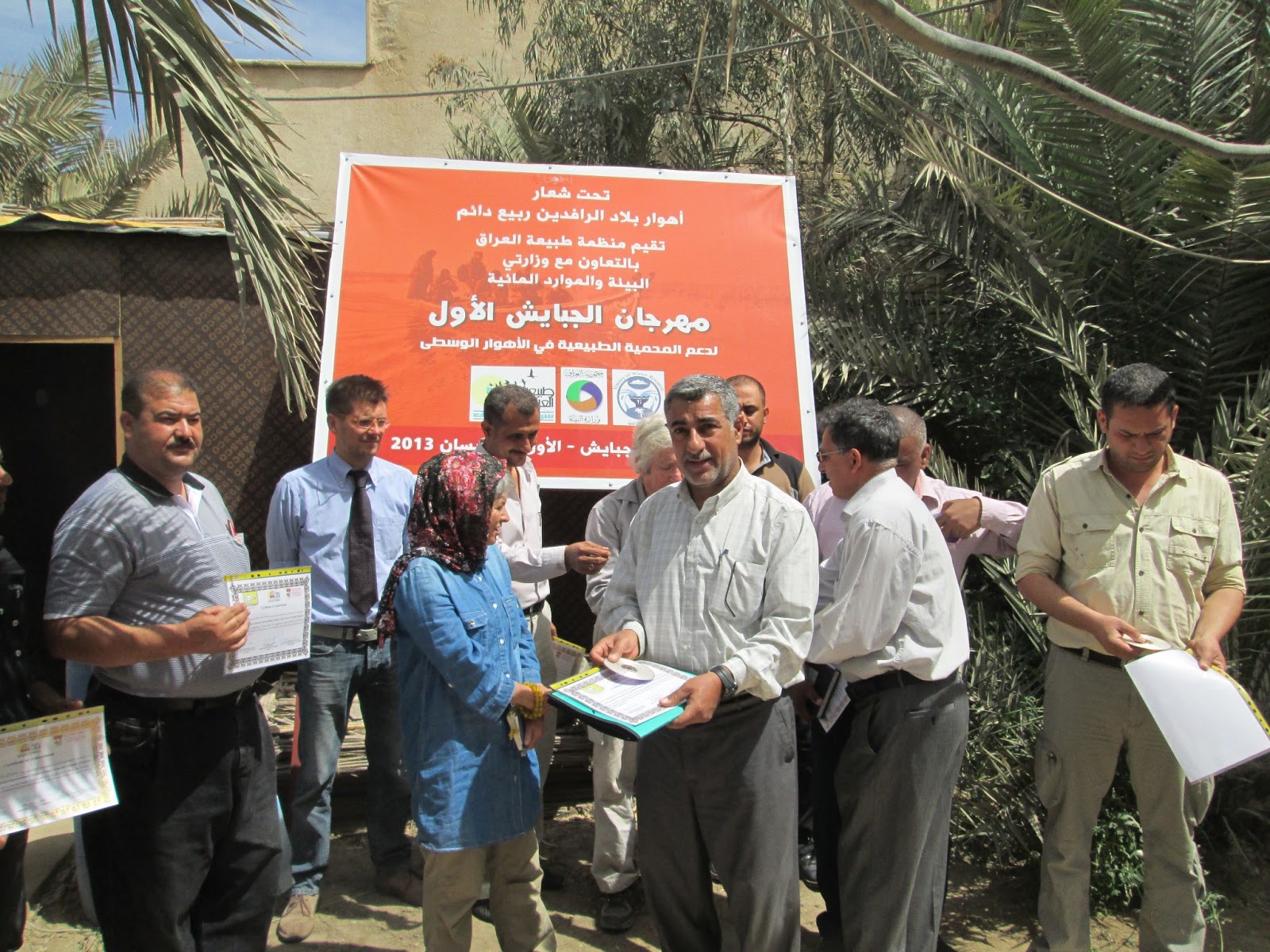
This is a great and emblematic picture.
This shows the team of technicians and members of the ministries and municipalities of Iraq who receive the certificate of participation in the workshop about "Treatment Wetlands with Wastewater gardens Technology" held in Iraq from 24 to 27 March 2013 (I'm the tie man... and with me Meridel Rubinstein and Mark Nelson).

About 25 participants know now what are the treatment wetlands technology and wastewatergardens, and can spread these information around this beautiful country. 
Thank you all of you!


Monday, April 1, 2013

constructed wetland in Iraq - my survey and my project

Well, after a week of survey, workshops and good local meals, I can show you some pictures about my activity there.
Yes Iraq can be considered a dangerous place, but I've met nice people, visited some very beautiful places and laid the foundation for a fruitful collaboration. Good luck to all of you in this journey of renewal.
I'll prepare a special post about the wastewatergardens technology and his team which gave me the opportunity to be an active part of this work. Thanks also to Meridel Rubistein to involve me in this international project!
I have visited four sites between the district of Nassirja and Basra. Two will be made to serve a local Shrine, one is for a private house and the last one is to serve the west part of the city of Chibaish. All sites are suitable.
Is not easy to start to work in a place where none know your technology, where you have to start from the base line of the functioning, where the climate is not your home weather, where you have to check all tha materials, where you have to found a local builders... etc. But is possible! and I'll explain what I have did.

First of all we have organized a good workshop with local people, members of the local municipality, Ministery of Water Resource and Environment, and anybody want to attend and learn more. Second we have visited the sites with the owners. Third we have contacted a local builders to discuss all about the materials and the construction steps. Fourth we have check the availability of the local species that can be used.
25 person attend at the three days of workshop. Thank to all of you!

site n. 1, the local men toilet discharge in the septic tank.... but we need also a beautiful wetland system! 

site n. 3: these men toilets need to go to the septic tank...which in a couple of months will done! 
YEAHHH also there there is washed gravel

checking the availability of pvc pipes, diameters ets...
discuss with a local gardener about the management of the plants

checking in a "mobile nursery" the price of the plants !!!!


Sunday, March 24, 2013

what you can do with the reeds from this Arab marches

here below I present what you can do with reed grown in these ancient Arab marches... all this is  Phragmites australis.....
here all the buffalo eat phragmites australis

the reeds are collected inside the Arab Marches and with the local boats the men goes to the market and sell it to the other farmer

reed dried under the sun...... or clothes driing under the sunset?
take a look to this beautiful reed mats ready to go to the market!

amazing reed mats waiting to go to the markets!

reed transportation
and obviously you can also build your houses!!!!!!


Saturday, March 23, 2013

iraq's ancient marches.... the Eden was here and we work to restore it!

Hi to all, yes is true, I'm here where the Eden begun!!! just few images from this first day. stay tuned for other in the next days


the Euphrate river

Sunday, March 10, 2013

Eden in Iraq

EDEN IN IRAQ

Ecological and Cultural Restoration through Art, Design, and Environmental Science in the  South Iraq  Marshes

Growing Beauty with the 7000 year old Marsh Arab Culture


Eden in Iraq is a land art project in the wetlands of southern Iraq using imagery and wastewater to create a garden to transform centuries of conflict into art. It will bring an effective, ecological treatment system for sewage and water recycling into a region which lacks such basic hygiene.

In 1991 Saddam Hussein drained the immense wetlands near the likely site of the Garden of Eden, turning it into a desert. The Marsh Arabs who were forced to leave have been returning to re-green and restore the marshes with the help of the Nature Iraq, an Iraqi NGO located in El-Chibaish, the largest Marsh Arab city in the region. Nature Iraq has invited artist Meridel Rubenstein and environmental engineer Dr. Mark Nelson, with landscape architect, Catherine Page Harris, to create an art/ecological work that will transform human waste into a garden, protecting the health of the local people and the rivers and marshes which sustain them. The project is also supported by the Institute of Ecotechnics .

The restoration of the priceless and historic Mesopotamian wetlands in southern Iraq is well underway. The work has been spearheaded by Dr. Azzam Alwash, an Iraqi-American engineer, founder of the Eden Again Project and Nature Iraq, with assistance from the Iraqi Government, the Canadian International Development Agency, the Italian Ministry of the Environment, Land and Sea, and the United Nations Environment Program. The area for millennia was home to the famed “Marsh Arabs” whose reed houses and reed boats, made from wetland reeds growing in the area made the region unique culturally. The area was heavily damaged during the decade-long Iran-Iraq war when sections were bombed and drained. After the uprising by the local peoples of the region against Saddam Hussein in the early 1990s, the Iraqi government in retaliation diverted the rivers and dried out most of the area, and forced most of the local population to move away. More recently, river flow has been restored and a good percentage of the wetland area is recovering, with an influx of Marsh Arabs back to their original homeland.

Nature Iraq is an Iraqi NGO (www.natureiraq.org) working on preservation of important ecological regions and distinctive cultures in Iraq. They have proposed the southern marsh area as the country’s first, the Mesopotamian National Park. The Institute of Ecotechnics (UK and US), founded in 1973, has been working on the theory and practice of integrating people, economics, technologies in sustainable relationships to our biosphere. IE holds conferences and workshops and consults to innovative projects around the world which serve as demonstrations of the ecotechnic approach.


the team:
Meridel Rubenstein, Project Director, is an Artist whose work focuses on the intersections of nature and culture in relationship to ecological and social imbalance. Presently she’s an Associate Professor at the School of Art, Design, and Media at Nanyang Technological University, in Singapore (Spring semesters only) where she teaches Photography, Installation, and Art and Ecology. She uses photography and sculpture to make her work. MA and MFA, Art Dept, University of New Mexico. http://www.meridelrubenstein.com
Mark Nelson, PhD is an Environmental Engineer, received his PhD with Prof. H.T. Odum at the
University of Florida Center for Wetlands. Director Institute of Ecotechnics, Santa Fe,NM , a member of the first biospherian crew in Biosphere 2) , and for the
past 15 years has been working globally on constructed wetland applications.
(http://www.wastewatergardens.com).
Catherine Page Harris, Assistant Professor of Art and Ecology, UNM Dept. Art and Art History,
is a landscape architect. Co-leader of Land Arts of the American West. Her current work focuses on interactions between ecological flows and human habitation. She creates mixed media installations and landscapes. Master of Landscape Architecture, UC Berkeley; Master of Fine Arts, Stanford University. http://cargocollective.com/landwork


Well, I'm really proud to annunce that I'm part this project by a Tier One Research grant  from  Nanyang Technological Unverisity. Stay tuned form upcoming news!!!


Tuesday, February 26, 2013

opinions on treatment wetlands

Hi,
Since 1996 I work in the field of treatment wetlands and I've heard of all colors (this is an italian way of saying to express  the fact that I have heard many speeches about TWs).

  • I'm sure that the wetland's cells doesn't smell,
  • I'm sure that the wetland's cells doesn't host wild animals that kill you
  • I'm sure that mosquitos cannot live there
  • You can walk on a vertical and horizontal beds; for the surface beds you need special boots or wearing the beautiful Hawaianas summer shoes
  • The wetland system last more than 20 years if you manage them well
  • They cost less than a traditional system (a little bit less but you have not the expensive management cost of the traditional systems)
  • Floating wetlands are a good way to treat on site the wastewaters
  • You can use local materials to build up the systems
  • You can use local species to plant the beds
  • Yes, it is true that the wetland needs land where build the beds.... but it is always better than a industrial area...


any other questions or opinions? help me to improve this list...

"greetings from Hamman-Jordan"

treatment wetlands on wiseGEEK

I was looking for something new about treatment wetland by a random research on the web and I found this portal "WiseGEEk" that  give clear answers for common question. I was wondering when I saw that there was an answer about treatment wetlands. that's good!

here the link to the web page: wisegeek treatment wetlands


Monday, February 25, 2013

hybrid constructed wetlands

Hybrid systems are a combination of vertical flow and horizontal systems arranged in a staged manner. HF systems cannot provide nitrification because of their limited oxygen transfer capacity. VF systems, on the other hand, do provide a good conditions for nitrification but no denitrification occurs in these systems. In hybrid systems (also sometimes called combined systems) the advantages of the HF and VF systems can be combined to complement processes in each system to produce an effluent low in BOD, which is fully nitrified and partly denitrified and hence has a much lower total-N outflow concentrations (J. Vymazal, Ecological Engineering, Volume 25, Issue 5, 1 December 2005, Pages 478–490 . Constructed wetlands for wastewater treatment, abstract.

When I start to design a wetlands I always ask to myself "horizontal or vertical ? or hybrid?". Well, is not difficult to answer! I take into account the volume, the number of people treated, the available surface, energy input, and so on.
Usually I start with the horizontal, easy to be design, easy to be realized, no energy needed, and a lot of advantages.
If I have more than 50, 100 .. 450 cubic meters a day I'm sure I do an hybrid wetland with VF before and HF after. Yes, if we are in a place where the surface is free, and where there are no other problem I do an HF, sure. But usually for large volumes is better the hybrid wetland. As noted in the Vymazal abstract, the chemical reactions that occour in the two systems are different. in the hybrid system we have both, and the treatment  efficiency will be higher in less space!

http://www.isprambiente.gov.it/files/pubblicazioni/manuali-lineeguida/Manuale_81_2012.pdf

For example you have to treat 100 m3 of municipal wastewater. 

1 Hp: only horizontal:
if you  build up only HF systems you need more or less 1800 square meters of treatment wetland

2 Hp: only vertical:
if you  build up only VF systems you need more or less 600 square meters of treatment wetland

3 Hp: hybrid system
if you  build up an hybrid wetland systems you need more or less 1200 square meters of treatment wetland

This comparison is not made for the capital cost of building and design, only to show you the difference between the design methods.
As you can see the VF surface is the lowest but usually you have to buy pumps systems and realize the tanks for the inlet pumping.
The HF have the highest surface but the lowest cost.
The hybrid is midway but be sure that will give you the best treatment performace you can reach because it combine aerobic and anaerobic environment.


Friday, February 22, 2013

WATER USE EFFICIENCY and FAO (Food and Agriculture Organization of the United Nations)


from FAO profile on facebook I copy this important article and also my comment. Yes, is important ot improve the water use ecciciency but is also important to start to reuse the treated wastewater. Treatment wetlands are a good way to treat wastewater and and give back H2O moleculae that could be reused for different purposes!

"The continuing population growth could double food demand in the next 50 years. Find out how better use of water could allow us to produce more food while preserving natural resources: http://bit.ly/XyGkOY"


and this is my comment:

"Davide Tocchetto: yes, is true, save water with improve efficiency but there is a large amount of water that can be reused, there are purification systems which allow to produce water that can be reused for different uses. One of this is treatment wetlands, a natural way to treat wastewater and get back clean water ... read more on www.treatmentwetlands.blogspot.com. A city with 100000 habitants produce 20000 mc a day of wastewater; this volume can generate 15000 mc/d of treated water that can be used for agriculture, irrigation, industrial processes. let's start to think also about the reuse!"


Friday, February 15, 2013

AQUAPONIC.... is a treatment wetland?


Aquaponics is a sustainable food production system that combines a traditional aquaculture farming with hydroponics in a symbiotic environment. 

In aquaculture, effluents accumulate in the water, increasing toxicity for the fish. 
This water is led to a hydroponic system where the "nutrients" from the aquaculture are filtered out by the plants for their life, after which the cleansed water is recirculated back to the animals.

Aquaponic systems vary in size from small indoor or outdoor units to large commercial units, using the same technology. The systems may contain fresh or salt water, depending on the plants and animals desired. (source, wikipedia mod.).

Now I'm partner in a Leonardo project with University of Padova and Lubiana, the Swiss ZAHW and three high schools (in Italy, Slovenia and Swiss). The aim of the project is realize an aquaponic system in the two schools.
But my question is... is aquaponic a kind of treatment wetlands? I think yes!
Yes because there is wastewater produced by the fish farming and yes because there is the biological absorption by the plants and finally the treated water is reused for the fish living...


A good example on expanding aquaponic culture is the URBAN FARMERS project in Swiss (UF web site). They are focused on building the best urban agriculture systems the world has ever seen. They are cost effective, sustainable and reliable. Their rooftop farm system grows fresh vegetables and fish, and adds a new experience for your customers. The proprietary hardware and software solution which we have developed keeps your farm working and connected to your community so anyone can see, smell, and taste the truly fresh food, anytime. (source UF web site). 
Take a look to thier UF globe project at http://urbanfarmers.com/productsservices/uf-globe/ it's fantastic!!! 
Here below a picture of the aquaponic module in ZAHW.


Thursday, February 7, 2013

permaculture and treatment wetlands

Permaculture is a branch of ecological science which develops sustainable architecture and self-maintained horticultural systems modeled from natural ecosystems.The design principles which are the conceptual foundation of permaculture were derived from the science of systems ecology and study of sustainable land use. Permaculture draws from several disciplines and  has been applied most commonly to the design of housing and landscaping, integrating techniques such as agroforestry, natural building, and rainwater harvesting within the context of permaculture design principles and theory (source: wiki mod).


On the web I have found The  Permaculture Research Institute of Australia that  work with individuals and communities worldwide to expand the knowledge and practice of integrated, sustainable agriculture and culture using the whole-systems approach of permaculture design. This will provide solutions for permanent abundance by training local people to become leaders of sustainable development in their communities and countries (source http://www.permaculturenews.org/about mod). very interesting web site, join it!!!!

.... and what do you think? do you think the treatment wetlands may not be a suitable systems? OHHH YESSS, take a look to the australian research site, you will find a good read about treatment wetlands. I want to mention them with his words reported below:

"These artificial wetlands provide a near zero energy input way to treat local effluent with no negative side effects. The process is free of both chemicals and odours, provides habitat for wildlife, increases the diversity and aesthetics of any site, and, depending on the toxicity of the inflowing effluent, can potentially create a yield, such as fodder for livestock." 

very good words! congratulations


Wednesday, January 30, 2013

follow this blog by e-mail

Ciao readers, hello wetland's friends ... please join the service " FOLLOW BY E-MAIL" that you find here in the  right sidebar. You will be update immediatly when I'll post the new articles.


Tuesday, January 29, 2013

my future on treatment wetland systems


For several years we are developing a product that will bring an extraordinary novelty in the field of wastewater treatment and its application on a large scale. As usual, the idea is good, the industry requires, its competitors are there but our product is better, blah blah blah.
The product is based on our experience in the field of treatment wetland  and have developed a good project idea to make this system with high aesthetic value, which is applicable in many realities, both Italian and foreign, and of course with sustainable positive impact.
To continue this adventure we  search designers who want to try to produce the true aesthetic and functional innovations in the coming years (Bill Gates is investing with his Foundation a lot of dollars in sustainable sanitation); seek investors who want to invest in the water sector and of water sanitation and health care to produce wealth and good for the environment and human beings.
We do not give the indifference of native capitalists we met in the last months........ Soon we will find an open door.